Gun Slang Terms: 35+ Meanings, Contexts & Examples
“Gun slang terms” are informal expressions used to refer to guns or firearms, especially in music, movies, fiction, texting, and online conversations. Common examples include gat, strap, piece, heater, and Roscoe.
If you have ever heard one of these words in a song or seen it in a movie and wondered what it meant, you are not alone. American slang changes quickly across generations, regions, and communities. This guide explains the language clearly, separates older expressions from contemporary ones, and shows why context matters when interpreting firearm-related slang.
Gun Slang Terms at a Glance
Some gun slang terms are widely recognizable, while others belong mainly to particular eras, regions, or cultural settings. Gat is an older American slang word for a handgun, while Roscoe is an old-fashioned term for a pistol or revolver. Strap, piece, heater, iron, and blicky can also appear in informal language.
The important point is that these expressions are not perfect substitutes in every sentence. A word can carry historical, regional, musical, fictional, or conversational associations. Blicky, for example, is more contemporary and regionally associated, while Roscoe tends to sound deliberately old-school. Meaning depends on the surrounding language.
| Gun slang term | General meaning | Typical context |
| Gat | Gun or handgun | American slang, music, older fiction |
| Strap | Gun or firearm | Contemporary slang, music |
| Piece | Gun or firearm | Fiction, casual dialogue |
| Heater | Gun | Older American slang |
| Iron | Gun in some contexts | Older slang, fiction |
| Burner | Gun in some contexts | Crime fiction, slang |
| Roscoe | Pistol or revolver | Older American slang |
| Heat | Gun in some contexts | Music, informal speech |
| Rod | Gun | Informal slang |
| Blicky | Pistol/firearm | Contemporary regional slang |
Dictionary references support several of these distinctions: gat is listed as slang for handgun, Roscoe as older slang for a revolver or pistol, and strap as slang for a gun.
Gun Slang Terms in Different Situations
The same expression can feel completely different depending on where it appears. A term heard in a rap lyric may be cultural storytelling, while the same word in a crime novel may deliberately create a historical atmosphere. Music, movies, gaming, texting, social media, and casual speech each give slang its own context.
When decoding unfamiliar gun slang, look at the entire sentence rather than isolating one word. Consider the speaker, platform, time period, region, and subject. This matters especially for words such as burner, iron, heat, and piece, which have ordinary meanings unrelated to firearms.
| Situation | What the slang may indicate |
| Music | Cultural or artistic language |
| Movies | Character or period-specific dialogue |
| Gaming | Often fictional weapon language |
| Social media | Fast-changing informal slang |
| Texting | Personal, conversational language |
| School | Usually educational discussion |
| Workplace | Clearer formal terminology is preferable |
Gun Slang Terms in Music and Popular Culture

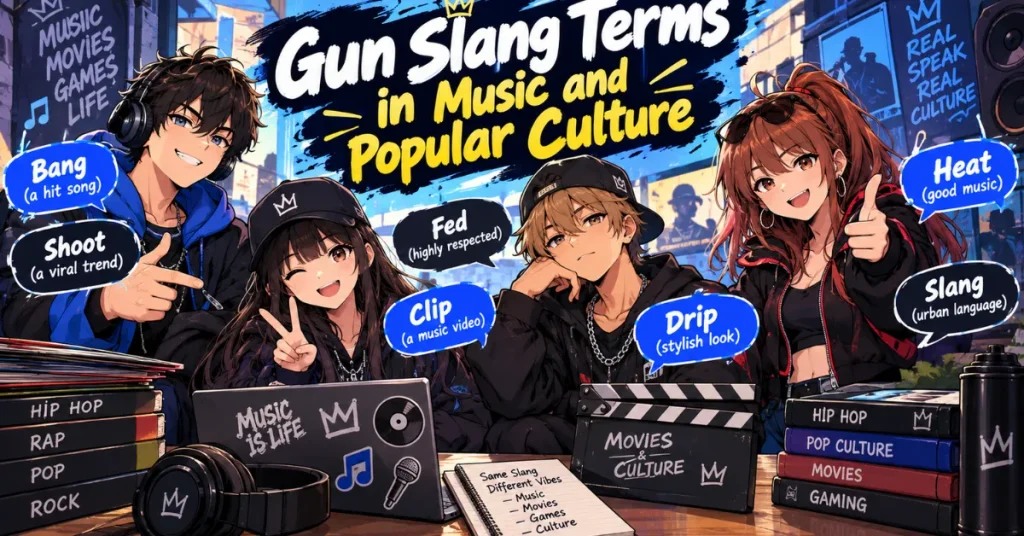
Music has helped preserve older gun slang while also introducing expressions to new audiences. Words such as gat, strap, piece, heat, and blicky can appear in rap or hip hop contexts, where language may communicate character, setting, identity, storytelling, or cultural references.
However, hearing a term in a song does not mean it is equally common in everyday American speech. Lyrics can preserve dated expressions for decades, while newer slang can spread rapidly through music and social media. That makes cultural context essential when interpreting a line.
Why Lyrics Can Be Difficult to Understand
Lyrics frequently compress language through regional slang, shortened expressions, metaphors, cultural references, and multiple-meaning words. A listener may recognize a term without knowing its historical background. The safest interpretation comes from considering the surrounding lyrics and the overall subject rather than translating one slang word literally.
Gun Slang Terms in Movies and TV
Movies and television often use firearm-related slang to make dialogue fit a character, location, genre, or historical period. A detective story might use Roscoe to create an older American atmosphere, while contemporary fictional dialogue may use strap or another newer expression.
This is one reason slang dictionaries should identify age and context. A term appearing in a classic crime film may sound strange in a modern conversation without actually being incorrect. Fiction often preserves vocabulary that has become less common in ordinary speech.
Gun Slang Terms in Gaming
Gaming introduces another layer because firearm-related words may refer entirely to fictional weapons. Players can use informal nicknames for game items without making a statement about real-world firearms. The same word can therefore have a gaming meaning that differs from its real-world slang meaning.
When reading gaming slang, identify the game and the surrounding discussion first. A term such as blaster can be especially broad because it is common in science fiction and gaming language. In that environment, it may describe an entirely fictional weapon rather than real world terminology.
Gun Slang Terms on TikTok, Instagram, and Reddit
Social platforms accelerate slang because music clips, memes, viral posts, comments, and creator communities can expose regional expressions to much larger audiences. Contemporary terms may suddenly become recognizable outside their original communities, while older expressions can return through songs, movies, or nostalgic content.
That does not mean every platform uses the same vocabulary. Blicky, for example, has strong regional and cultural associations, while gat has a much longer history. When you see unfamiliar gun slang online, read the surrounding comments and identify whether the discussion is about music, fiction, gaming, humor, or a real world event.
Are Gun Slang Terms Appropriate at Work?
Usually, firearm slang is not the clearest choice for professional communication. Workplace emails, reports, presentations, customer communication, and official documents generally benefit from neutral terms such as gun or firearm. Clear wording reduces ambiguity and avoids unintended alarm.
The same principle applies to schools and other formal environments. If you are discussing slang academically, explain the word rather than using it casually. Context can completely change how a phrase is perceived, particularly when the underlying subject is a serious real world issue.
At Work
Formal writing should favor straightforward vocabulary. If a report needs to discuss a firearm, gun or firearm is usually clearer than a slang nickname. Slang can be useful when analyzing a song, novel, movie, or social-media post, but it should be identified as vocabulary being discussed rather than ambiguous wording.
Quick Comparison of Common Terms: Gun slang terms
| Term | Basic meaning | Age/context |
| Gat | Gun or handgun | Older American slang; still recognized |
| Piece | Gun/firearm | Long-established informal term |
| Strap | Gun/firearm | Contemporary informal usage |
| Heater | Gun | Older American slang |
| Iron | Gun in some contexts | Older/context-dependent |
| Burner | Gun in some contexts | Highly context-dependent |
| Roscoe | Pistol/revolver | Old-fashioned American slang |
| Heat | Gun in some contexts | Context-dependent |
| Rod | Gun | Informal slang |
| Blicky | Pistol/firearm | Contemporary/regional |
These terms should not be treated as interchangeable in every sentence. Gat has a documented history as slang for a handgun and is associated with the shortened form of “Gatling gun.” Roscoe is documented as older American slang for a revolver or pistol, while blicky is a more contemporary regional term for a pistol.
Common Questions About Gun Slang Terms
What is the most common slang word for a gun?
There is no single slang term that is equally common everywhere. Gat, piece, strap, heater, and rod are widely recognizable, but popularity changes according to region, generation, music scene, and historical period.
What does “gat” mean?
Gat is American slang for a gun, particularly a handgun. Major dictionary sources document it as slang and connect its origin with a shortening of Gatling gun.
What does “strap” mean in slang?
Strap can mean a gun in contemporary informal slang. Cambridge Dictionary specifically records this slang meaning, although the word has many ordinary meanings unrelated to firearms.
What does “piece” mean in slang?
Piece can be an informal term for a gun or firearm. Because piece has many ordinary meanings, you need the surrounding sentence to determine whether the firearm meaning is intended.
Is “heater” slang for a gun?
Yes. Heater is an older American slang term for a gun and appears particularly often in crime fiction, older movies, and historical-style dialogue.
What does “Roscoe” mean?
Roscoe is old American slang for a pistol or revolver. Dictionary.com and Collins both identify it as older or old-fashioned slang, with the word recorded in the early 20th century.
Does “burner” always mean a gun?
No. Burner has several meanings. It can refer to a temporary phone, a cooking device, or a firearm in particular slang contexts. The surrounding sentence is essential.
What does “blicky” mean?
Blicky is contemporary slang for a pistol or firearm, especially associated with certain American regional and music communities. Its meaning should not automatically be generalized to every English-speaking community.
Are gun slang terms appropriate for professional writing?
Generally, no. Gun or firearm is clearer and more neutral for professional, academic, legal, workplace, or safety-related communication.
Why are gun slang terms difficult to understand?
They change across time, region, age group, community, platform, and culture. Some terms also have completely unrelated everyday meanings, so context is often more useful than memorizing a dictionary list.

Daniel Parker is a writer and language enthusiast with a passion for modern slang, internet culture, and the way people communicate online.
As the creator and contributor at posmeaningslang.com, Daniel focuses on making slang words, phrases, abbreviations, and online expressions easier to understand. His goal is to provide clear definitions, useful examples, and simple explanations that help readers understand the language they encounter every day.
Daniel enjoys exploring how language evolves across social media, texting, gaming, and online communities. He believes that understanding modern slang isn’t just about knowing words—it’s about understanding the context and culture behind them.
Through posmeaningslang.com, Daniel aims to create a helpful and easy-to-use resource for anyone looking to understand today’s slang and internet language.
Areas of Interest: Slang • Internet Language • Social Media • Modern Communication • Language & Culture