K Meaning in Chat: What Does “K” Mean in Text Messages?
Someone sends you a message, and you reply with a question. Instead of a full answer, you get one letter: K. Does it mean okay, or is the person annoyed with you?
In texting, K usually means “okay,” “got it,” or “I understand.” It is a short form of OK that people use in everyday conversations, group chats, and social media messages. The tone can feel friendly, neutral, or cold depending on the situation. For example, K after a meeting time may simply confirm the plan, while K after an argument may leave you wondering how the other person feels. The best way to understand it is to read the message in context.
What Does K Mean in Chat and Texting?
K is a common shorthand for OK or okay. People use it to acknowledge information, accept a suggestion, or show that they have read a message.
Here is a quick reference:
| Text message | Likely meaning |
|---|---|
| “Meet me at 6.” “K.” | I understand. |
| “I sent the file.” “K.” | I got your message. |
| “Let’s get pizza tonight.” “K.” | Okay, that works. |
| “Don’t forget your homework.” “K.” | I understand the reminder. |
Quick answer: K usually means okay in chat. It does not automatically mean someone is angry, bored, or upset.
Different Meanings of K in Text Messages
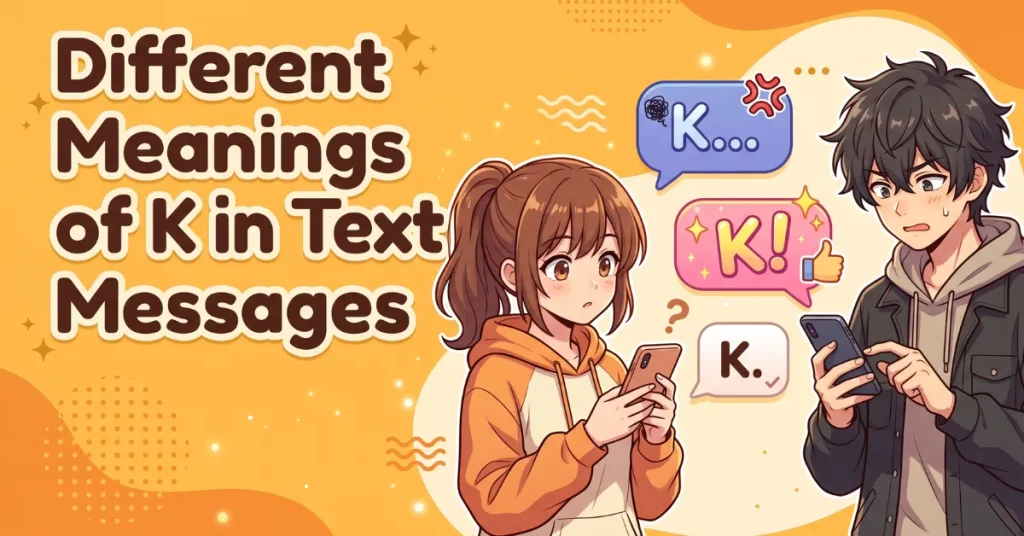
Although K most often means okay, its purpose can change with the conversation.
Acknowledgment: Someone sends K to show they have seen your message.
Example:
You: “The class has moved to Room 12.”
Friend: “K.”
Meaning: They have received the information.
Agreement: K may show that a person accepts a plan or suggestion.
Example:
You: “I’ll meet you outside the library at 4.”
Friend: “K.”
Meaning: They understand the arrangement, although a clearer reply would confirm that they will attend.
A quick response: Some people type K because they are busy or prefer short messages. They may use it without thinking about how it sounds.
A possible sign of frustration: After a disagreement, K can feel distant or dismissive. However, the message alone cannot confirm the sender’s mood.
A conversation ending: If both people have finished discussing a topic, K may simply close the exchange.
The important difference is between what the message literally says and what you think the sender feels. K can communicate acknowledgment, but it gives limited information about emotion.
K Meaning on WhatsApp, Instagram, Snapchat, and TikTok
K generally means okay across messaging platforms. The app itself does not give the letter a separate meaning.
| Platform | Example | Likely meaning |
|---|---|---|
| “Dinner at 8?” “K.” | Acknowledgment | |
| Instagram DM | “I sent you the link.” “K.” | Message received |
| Snapchat | “I’ll reply after class.” “K.” | Okay, understood |
| TikTok messages | “Check the video I shared.” “K.” | Acknowledgment |
| SMS or iMessage | “Pick me up at 5.” “K.” | The message was seen |
These are illustrative examples, not official definitions for each platform.
If a message needs a definite answer, avoid relying on K alone. For example, “Are you bringing the tickets?” followed by K does not clearly confirm that the person will bring them.
Is K Rude in Texting? Meaning From a Girl or Guy
K can sound rude, but it is not rude in every situation. Some readers see it as blunt because it is so short. Others use it as a normal reply to everyday messages.
What Does K Mean When a Girl Says It?
When a girl texts K, it usually means okay or that she has understood your message. It does not automatically mean she is angry, losing interest, or trying to end the relationship.
Consider these examples:
A normal reply
You: “I’ll call you after work.”
Her: “K.”
Possible meaning: She has understood your plan.
A reply after an argument
You: “I’m sorry I forgot to tell you.”
Her: “K.”
Possible meaning: She may still feel upset, but she might also need time or have nothing else to say.
A reply that seems different from usual
If she normally sends longer messages and suddenly replies with K, you may notice the change. Still, one short message is not enough to explain why it happened.
What Does K Mean When a Guy Says It?
When a guy sends K, it usually has the same basic meaning: okay, understood, or got it. It does not prove that he is annoyed, uninterested, or trying to ignore you.
Look at the topic, his usual texting habits, and the messages around it. If you need to know what he means, asking directly is more reliable than guessing.
Real Chat Examples of K and What They Mean
These examples show why context matters more than the letter alone.
Example 1: Making plans
You: “The game starts at 7.”
Friend: “K.”
Likely meaning: They have received the time.
Example 2: Sharing school information
You: “The assignment is due Monday, not Friday.”
Classmate: “K, thanks.”
Likely meaning: They understand the update.
Example 3: Talking about a problem
You: “I didn’t mean to upset you.”
Them: “K.”
Possible meaning: They may be frustrated, but their feelings cannot be confirmed from this reply alone.
Example 4: Asking a direct question
You: “Are you coming to the party?”
Them: “K.”
Likely issue: The answer is unclear. Ask, “Does that mean yes?”
Example 5: A routine reminder
You: “Bring your charger tomorrow.”
Friend: “K.”
Likely meaning: They acknowledge the reminder.
How to Reply When Someone Texts K
You do not need to assume something is wrong whenever someone sends a short response. Choose your reply based on the situation.
| Situation | A suitable response |
|---|---|
| They confirm a plan | “See you there!” |
| They acknowledge information | No reply needed |
| You need a definite answer | “Just checking, are you coming?” |
| The conversation feels tense | “Are we okay? We can talk if something is bothering you.” |
| You are unsure what they mean | “Do you mean yes?” |
If the message concerns an important plan, ask a clear question. If it is an ordinary exchange, there may be no need to reply at all.
K vs OK vs Okay vs KK: What’s the Difference?
K, OK, okay, and KK are closely related, but readers may interpret their tone differently.
| Form | Common use | How it may sound |
|---|---|---|
| K | Short acknowledgment | Sometimes blunt |
| OK | Agreement or acknowledgment | Often neutral |
| Okay | Everyday written response | Neutral or conversational |
| KK | Casual acknowledgment | Sometimes playful or friendly |
These tone differences are not fixed rules. A person may use all four forms in the same way.
Why Do People Text KK?
People use KK as a quick way to say okay. Some find it more casual or friendly than a single K. Others use it simply because it is part of their normal texting style.
Example:
You: “I’ll message you when I get home.”
Friend: “KK.”
Meaning: Okay, understood.
KK does not guarantee that the person is happier or friendlier than someone who replies with K.
Is K Slang for OK?
Yes. K is commonly used as informal shorthand for OK in messages and online conversations. It is a brief acknowledgment rather than a word with one fixed emotional meaning.
When Should You Avoid Using K in Text Messages?
K works well for quick, casual exchanges, but a longer answer may be better when clarity or warmth matters.
Consider using a complete sentence when:
- Apologizing: “I understand, and I’m sorry” communicates more than K.
- Discussing a serious issue: A one letter response may make the other person feel dismissed.
- Confirming plans: “Yes, I’ll be there at 6” gives a clear answer.
- Messaging a teacher or employer: A polite, complete response is usually more suitable.
- Offering reassurance: Tell the person what you mean instead of leaving them to guess.
You do not have to stop using K. Just consider how your message might be read by someone who cannot hear your voice or see your facial expression.
Other Meanings of K Beyond Texting
K can have different meanings outside casual messages. The surrounding words and subject help identify the correct one.
| Context | Meaning | Example |
|---|---|---|
| Texting | Okay | “K, see you soon.” |
| Numbers and social media | Thousand | “10K followers” means 10,000 followers. |
| Chemistry | Potassium | K is the chemical symbol for potassium. |
| Temperature | Kelvin | K is the symbol used for the kelvin unit. |
If someone sends K by itself in a casual conversation, okay is a likely interpretation. Beside a number or in a scientific discussion, it may mean something else.
Common Misunderstandings About K in Text Messages
Thinking K always means anger: Many people use it as a neutral acknowledgment.
Assuming someone has lost interest: A short reply cannot establish a person’s feelings about you.
Believing KK always sounds friendlier: Some people see it that way, but usage differs from person to person.
Ignoring the question that came before it: K may acknowledge information without answering a direct question.
Treating a guess as a fact: If the meaning matters, ask for clarification rather than assuming the worst.
Frequently Asked Questions
What is K in texting?
K is a shortened form of OK or okay. It commonly means “got it,” “I understand,” or “all right.”
What is K in slang?
In casual texting, K is shorthand for okay. Its tone depends on the conversation and the person using it.
Why do people text KK?
People use KK to acknowledge a message quickly. It may sound more casual or friendly to some readers, but it does not have a universal emotional meaning.
Is K slang for OK?
Yes. K is commonly used as an informal version of OK in text messages and online chats.
What does K mean when a girl says it?
It usually means okay or acknowledgment. It does not automatically mean she is annoyed, uninterested, or upset.
Does K mean someone is mad at me?
Not necessarily. Consider the conversation and the person’s usual texting style. If something feels wrong, ask them calmly.

Daniel Parker is a writer and language enthusiast with a passion for modern slang, internet culture, and the way people communicate online.
As the creator and contributor at posmeaningslang.com, Daniel focuses on making slang words, phrases, abbreviations, and online expressions easier to understand. His goal is to provide clear definitions, useful examples, and simple explanations that help readers understand the language they encounter every day.
Daniel enjoys exploring how language evolves across social media, texting, gaming, and online communities. He believes that understanding modern slang isn’t just about knowing words—it’s about understanding the context and culture behind them.
Through posmeaningslang.com, Daniel aims to create a helpful and easy-to-use resource for anyone looking to understand today’s slang and internet language.
Areas of Interest: Slang • Internet Language • Social Media • Modern Communication • Language & Culture