
Australian Insults: 30+ Aussie Slang Roasts & Meanings
Australian insults are usually colorful ways to tease, joke with, or criticize someone, and drongo is one of the best-known examples. If you are learning Aussie slang, the tricky part is not memorizing words; it is understanding tone, friendship, context, and Australian humor. Terms such as galah, dill, bogan, dag, ratbag, wanker, sook, and bludger can range from affectionate banter to a genuine put-down. After researching Australian English and comparing modern usage, I’ve found that the safest approach is simple: learn the meaning, watch how locals use it, and consider the relationship before repeating it.
For Americans and other English speakers, Australian insults can sound much harsher than intended. Aussie slang, Australian English, friendly banter, mateship, teasing, and larrikin humor all shape how these expressions work in everyday conversation. A word that sounds rude on paper may be a joke between close friends, while a mild-looking term can feel insulting in the wrong setting. This guide breaks down the most useful Australian insults, explains their tone and context, and gives you practical examples so you can understand the language without accidentally crossing a social line.
What Are Australian Slang Insults

Australian slang insults are informal expressions used to tease, mock, criticize, or jokingly describe someone’s behavior. Common examples include drongo, galah, dill, dag, ratbag, and bogan. Some are mild and affectionate, while others, including wanker and tosser, can express genuine annoyance or contempt.
The important point is that Australian insults do not have one fixed emotional meaning. Tone, relationship, setting, delivery, humor, and familiarity can completely change how a phrase lands. Australian language research also connects joking abuse with ideas such as mateship, egalitarianism, informality, and self-deprecating humor. That makes context just as important as the dictionary definition.
The Most Common Australian Insults Explained
If you want the Australian insults you are most likely to encounter, start with drongo, galah, dill, bogan, dag, ratbag, bludger, wanker, sook, nong, dropkick, and boofhead. They cover several common targets, including foolish behavior, arrogance, laziness, complaining, and mischievous behavior.
Some of these terms have deep roots in Australian English, while others overlap with wider English slang. Their social strength also varies considerably. A drongo can sound almost affectionate between mates, whereas wanker is substantially sharper. Learning that scale is more useful than memorizing a flat list of definitions.
Drongo
Drongo means a stupid, foolish, or clumsy person and is one of the clearest examples of Australian insult slang. It is often mild enough for friendly teasing. You might hear, “You left your keys in the car again, you drongo.” Oxford records the Australian slang sense as “a stupid person.”
Galah
A galah is a silly or foolish person, with the word also referring to Australia’s distinctive pink-and-grey cockatoo. Its bird association gives the insult a humorous image, which helps explain why it often sounds playful. Among friends, “You galah” can be teasing rather than seriously hostile.
Bogan
Bogan is more complicated than a simple synonym for “idiot.” It can describe someone perceived as rough, uncultured, or associated with a particular working-class style or lifestyle. Because it can carry social or class connotations, it is safer to understand the context before using it about someone you barely know.
Dill

Dill is a mild Australian insult for someone being foolish, silly, or careless. It is closer to “goof” or “silly person” than a severe attack. Because the word is relatively soft, it can work naturally among family members, friends, or people joking about a harmless mistake.
Wanker
Wanker is considerably stronger. It commonly describes someone perceived as arrogant, pretentious, self-important, or unpleasant. Although friends may use it jokingly, you should not assume that every use is friendly. In a workplace or with a stranger, it can sound plainly rude and confrontational.
Sook
Sook refers to someone who complains, sulks, or behaves like a crybaby. The term is often used playfully when someone is making a big deal out of a small problem. For example, a friend complaining dramatically about a minor inconvenience might jokingly be called a sook
Funny Australian Insults That Sound Hilarious
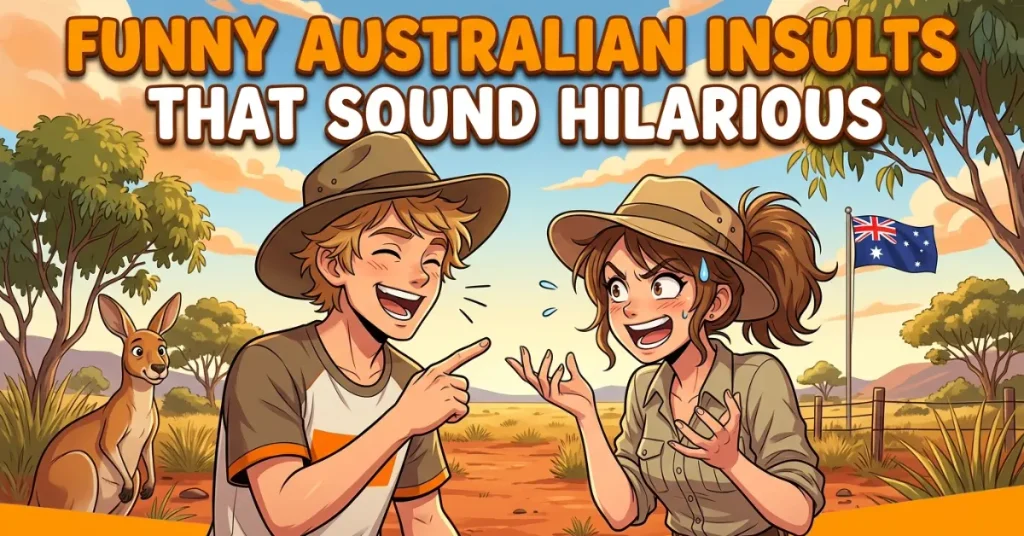
Australian insults are famous for turning criticism into ridiculous imagery. Expressions such as “you bloody galah,” “you absolute drongo,” “what a pork chop,” “head like a dropped pie,” and “as useful as an ashtray on a motorbike” rely on absurdity as much as insult. That comedy can soften the intended criticism.
The humor works because the language often sounds exaggerated rather than threatening. Australian English has a long tradition of colorful informal expression, and modern Australian sources continue to highlight friendly insults as part of Aussie conversational culture. The trick is recognizing that a funny phrase is not automatically safe with everyone; familiarity still matters.
Australian Insults for Someone Who Is Being Foolish
For someone acting foolish, Australian English offers plenty of options. Drongo, dill, galah, nong, boofhead, goose, muppet, pelican, and gronk can all describe foolish or clueless behavior, although their tone varies. Drongo and dill are generally easier to understand as mild teasing.
Consider the situation before choosing one. Calling your close friend a “boofhead” after they make an obvious mistake can sound affectionate. Calling a stranger a stronger insult after a disagreement is different. The relationship, facial expression, voice, and surrounding conversation can turn the same vocabulary into either banter or conflict.
Australian Insults vs American Insults
Australian insults often overlap with American English but can carry a noticeably different social flavor. Drongo is roughly comparable to “idiot” or “goofball,” while bludger can resemble “slacker.” Galah may work somewhat like “goofball,” while bogan has only a loose comparison with American terms such as “redneck.”
The difference is not simply vocabulary. Australian banter frequently uses humor, understatement, animal imagery, exaggeration, and self-deprecation. American speakers can therefore misread an Aussie insult as more hostile than intended. Conversely, an Australian speaker using a stronger American-style insult may sound unusually direct depending on the situation.
| Australian term | Approximate U.S. meaning | Typical feel |
| Drongo | Idiot / goofball | Mild |
| Galah | Silly person | Mild |
| Dill | Fool / goof | Mild |
| Bludger | Slacker | Mild to medium |
| Bogan | Rough or uncultured person | Context-dependent |
| Wanker | Arrogant jerk | Strong |
| Tosser | Obnoxious person | Strong |
| Ratbag | Mischievous troublemaker | Playful |
These are approximate equivalents, not perfect translations. Slang rarely maps one-to-one between cultures.
Are Australian Slang Insults Still Used Today
Yes, many Australian slang insults remain recognizable and useful, although their popularity varies by age, region, social group, and situation. Terms such as drongo, galah, dill, bogan, and wanker continue to appear in conversation, while some older expressions are less familiar to younger speakers.
Current linguistic research also confirms that Australian insults change over time. Monash University highlighted differences between generations, regions, and social contexts when discussing how Australian slang and offensive language evolve. Social media and online communities can accelerate that change by introducing, reviving, or reshaping expressions.
Aussie Insults That Sound Worse Than They Actually Are
Some Australian insults look harsh when translated literally but can be surprisingly mild between friends. Drongo, galah, dill, dag, and ratbag can function as playful teasing when delivered with a smile. The Australian context can therefore soften a word that might sound much more serious to an outsider.
That does not mean every insult is harmless. Wanker, tosser, gronk, and some uses of bogan can carry substantially more weight. Australian slang is not a permission slip to insult anyone you want. The safest interpretation comes from tone, relationship, setting, and whether the other person is clearly participating in the joke.
Australian Insults You Should Avoid With Strangers

The safest rule is to begin with understanding rather than performing. If you have just met an Australian, avoid assuming that calling them a bogan, wanker, tosser, or gronk will make you sound funny or culturally fluent. Strong slang can feel forced, disrespectful, or simply awkward when there is no established rapport.
Professional situations require even more caution. A workplace conversation, interview, customer interaction, or first meeting is rarely the right place to experiment with insults. Listen first, notice how people around you speak, and reserve stronger Australian slang for relationships where you already know the humor is welcome.
Australian Insults in Texting and Online Chats
Australian insults also appear in texts, group chats, gaming conversations, and social-media comments. A friend replying “you absolute drongo” after a silly mistake may be joking, while a stranger using the same phrase during an argument could mean genuine criticism. Digital communication removes facial expressions, so ambiguity becomes greater.
Online, gronk, drongo, galah, bogan, muppet, and other casual terms can appear alongside memes, jokes, sports commentary, and group banter. Because text removes voice and body language, look at the surrounding messages. If everyone is joking and responding playfully, it is probably banter; if the conversation has turned hostile, do not assume the slang is affectionate.
FAQ
What is an Australian cuss word?Common Aussie
Common Aussie cuss words include bloody, bugger, arsehole, bastard, fuckwit, and wanker, depending on context.
What are 5 Aussie slang phrases?
G’day (hello), mate (friend), no worries (it’s okay), arvo (afternoon), and fair dinkum (genuine/true).
Is it ooroo or hooroo?
Both “ooroo” and “hooroo” are Australian informal ways of saying goodbye, but “hooroo” is the more commonly recognized spelling.
What is a bogan Aussie?
A bogan is Australian slang for a person stereotypically associated with a rough, unsophisticated, or working-class lifestyle. It can be insulting or used playfully among friends.

Daniel Parker is a writer and language enthusiast with a passion for modern slang, internet culture, and the way people communicate online.
As the creator and contributor at posmeaningslang.com, Daniel focuses on making slang words, phrases, abbreviations, and online expressions easier to understand. His goal is to provide clear definitions, useful examples, and simple explanations that help readers understand the language they encounter every day.
Daniel enjoys exploring how language evolves across social media, texting, gaming, and online communities. He believes that understanding modern slang isn’t just about knowing words—it’s about understanding the context and culture behind them.
Through posmeaningslang.com, Daniel aims to create a helpful and easy-to-use resource for anyone looking to understand today’s slang and internet language.
Areas of Interest: Slang • Internet Language • Social Media • Modern Communication • Language & Culture