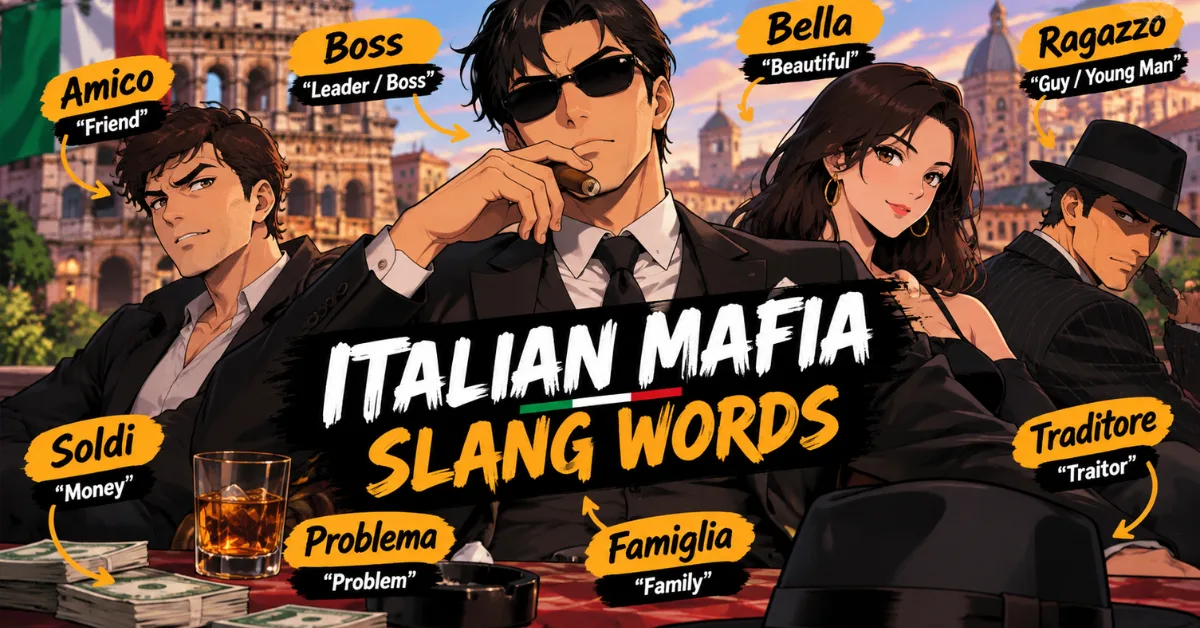
Italian Mafia Slang Words: 30+ Mob Terms Explained
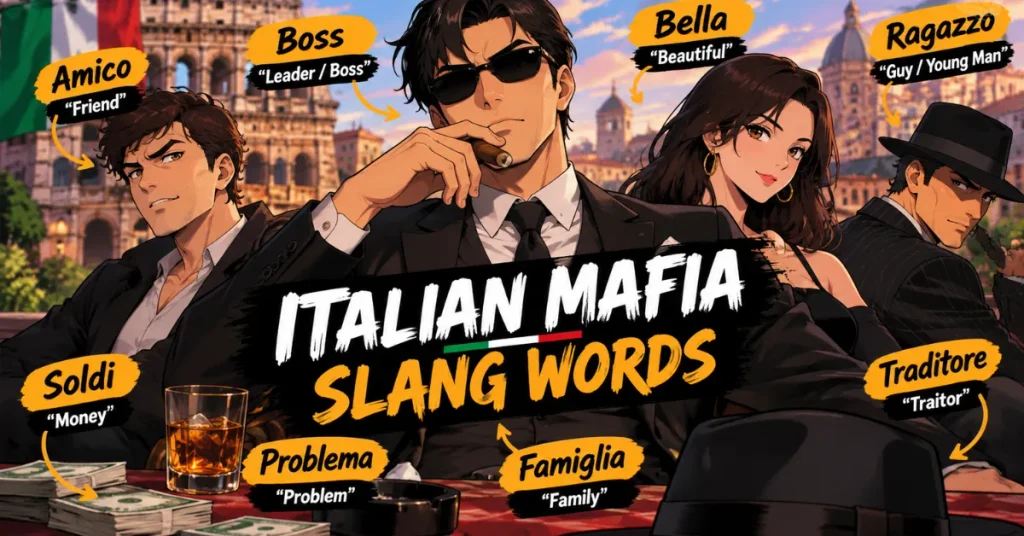
Italian Mafia slang words are a mix of Italian expressions, Sicilian terminology, Italian-American dialect, and American mob vocabulary, and knowing the difference makes these terms much easier to understand. If you’ve heard capo, omertà, goombah, or Cosa Nostra in The Sopranos, Goodfellas, or The Godfather, you’re hearing a blend of real organized-crime terminology and language shaped by popular culture. This guide separates those categories so you can understand what the words actually mean, where they come from, and how Americans commonly encounter them today.
Italian Mafia Slang Words: Quick Reference Table
| Term | Common meaning | Category |
| Capo | Crew leader or captain | Mafia terminology |
| Don | Boss or leader | Mafia terminology |
| Underboss | Second-in-command | Mafia terminology |
| Consigliere | Adviser to the boss | Mafia terminology |
| Soldier | Initiated member | Mafia terminology |
| Made man | Formally initiated member | American Mafia terminology |
| Associate | Non-member connected to a crew | Mafia terminology |
| Omertà | Code of silence | Mafia-associated term |
| Cosa Nostra | “Our thing” | Organizational term |
| Wiseguy | Mob member / gangster | American slang |
| Goombah | Friend or associate in Italian-American usage | Italian-American slang |
| Sit-down | Formal meeting | Mob vocabulary |
| Beef | Dispute or grievance | General American slang |
| Pinched | Arrested | American street slang |
| Feds | Federal law enforcement | American slang |
| Gabagool | Italian-American pronunciation of capicola | Dialect |
| Goomah | Mistress in Italian-American usage | Italian-American slang |
The most important distinction is that not every famous “Mafia word” is actually Italian. FBI material, for example, uses boss, underboss, consigliere, capo, soldier, made member, and associate as established terminology for American La Cosa Nostra.
Italian Mafia Slang Words: A Quick Note on Where This Language Comes From
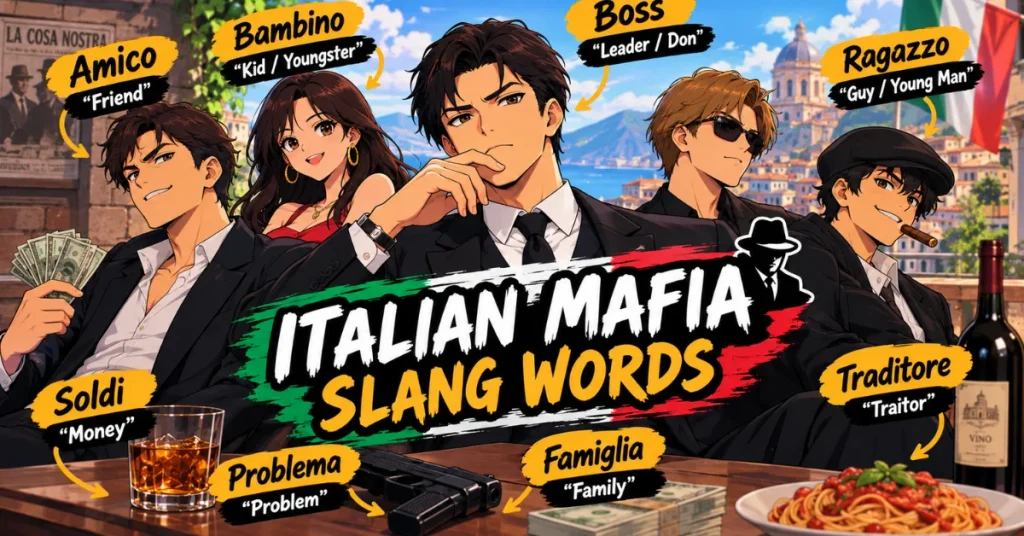
The phrase “Italian Mafia slang” covers several overlapping linguistic traditions. Some words come directly from Italian or Sicilian usage, while others developed in Italian-American communities and still others are ordinary American slang that became strongly associated with Mafia stories. That distinction matters because calling every mob-related expression “Italian” can create a misleading picture of the language.
Italian-American communities in places such as New York, New Jersey, Chicago, Boston, and Philadelphia helped produce distinctive speech patterns through contact between immigrant languages, regional dialects, and American English. Meanwhile, Cosa Nostra terminology developed within organized-crime structures and was later popularized through newspapers, books, films, television, and documentaries. Official U.S. records independently document the organizational vocabulary.
Italian Mafia Slang Words: The Big Words And What They Actually Mean
Omertà The Code of Silence
Omertà is one of the best-known Mafia-associated terms. It refers broadly to a code or expectation of silence and non-cooperation with authorities. In American La Cosa Nostra sources, the term is specifically connected with the oath of secrecy taken by initiated members. That makes it different from ordinary Italian words for silence.
Cosa Nostra “Our Thing”
Cosa Nostra literally means “our thing” and became a major name associated with the Italian-American Mafia. The FBI describes La Cosa Nostra, or LCN, as an organized crime network operating through families, crews, made members, and associates. The phrase therefore has a specific historical meaning beyond the casual translation “our thing.”
Capo Captain
A capo, short for caporegime or related organizational terminology, is a ranking member who leads a crew. The FBI describes a capo as a made member who commands soldiers within a crew. So although people sometimes casually use capo to mean “boss,” its Mafia usage can refer more specifically to a crew level leader.
Consigliere The Advisor
A consigliere is an adviser or counselor to the boss. The word itself is Italian, but its Mafia specific meaning comes from the organizational structure of La Cosa Nostra. FBI descriptions characterize the consigliere as a trusted adviser and confidant who occupies a senior position within a crime family.
Made Man A Full Member
A made man is an initiated member of an American Mafia family. Federal court documents describe soldiers as members formally initiated through a “making ceremony,” after which they are regarded as made members. The expression is therefore more specific than simply calling someone a gangster or associate.
Wiseguy
Wiseguy is an American expression strongly associated with organized crime and Italian-American Mafia culture. In federal case documents, soldiers have been referred to as “wiseguys,” although outside that context wiseguy can simply mean a smart aleck or someone being sarcastic. Context is what determines the meaning.
Goombah
Goombah is commonly encountered in Italian American slang and Mafia-themed entertainment as a word for a friend, buddy, or associate. Unlike capo or consigliere, it is not a formal rank in the Mafia hierarchy. Its popular association with mob culture is stronger than its usefulness as an organizational term.
Italian Mafia Slang Words: Using Slang Naturally Without Sounding Awkward
The safest way to use Italian Mafia slang is to treat it as cultural vocabulary rather than a costume. Capo makes sense when discussing Mafia hierarchy, while omertà fits conversations about secrecy or organized crime history. Words such as goombah can sound deliberately old fashioned or stereotypical outside Italian American cultural contexts.
Popular entertainment also encourages exaggeration. The Sopranos, Goodfellas, and The Godfather have made certain expressions recognizable worldwide, but fictional dialogue should not automatically be treated as evidence of how real organized crime members spoke. The strongest usage comes from understanding whether a term is Italian, Italian American, organizational, historical, or simply American slang associated with mob stories.
Italian Mafia Slang Words: Generational Slang Comparison
Older audiences may recognize Italian American expressions from family communities, neighborhood speech, or classic crime films, while younger audiences are more likely to encounter terms through streaming television, memes, TikTok, gaming, and internet culture. A word can therefore survive culturally even when its original community usage becomes less common.
Terms such as capo, wiseguy, omertà, made man, and Cosa Nostra remain recognizable because entertainment repeatedly recycles them. Meanwhile, expressions such as gabagool have become cultural shorthand for a particular Italian American pronunciation rather than evidence of Mafia membership. That distinction is useful when interpreting modern slang.
Italian Mafia Slang Words: Common Slang Mistakes
One common mistake is treating every Italian sounding word as Mafia slang. Gabagool, for example, is associated with Italian American pronunciation of capicola, not a secret Mafia code word. Likewise, consigliere is an ordinary Italian word meaning counselor or adviser, even though Mafia culture gave it a specialized organizational meaning.
Another mistake is assuming that movie dialogue represents authentic historical speech. Crime dramas compress, exaggerate, and stylize language for storytelling. Federal sources provide a better reference for terms describing actual American Mafia structures, including families, crews, capos, soldiers, made members, associates, underbosses, and consiglieri.
Italian Mafia Slang Words: Why This Language Still Matters
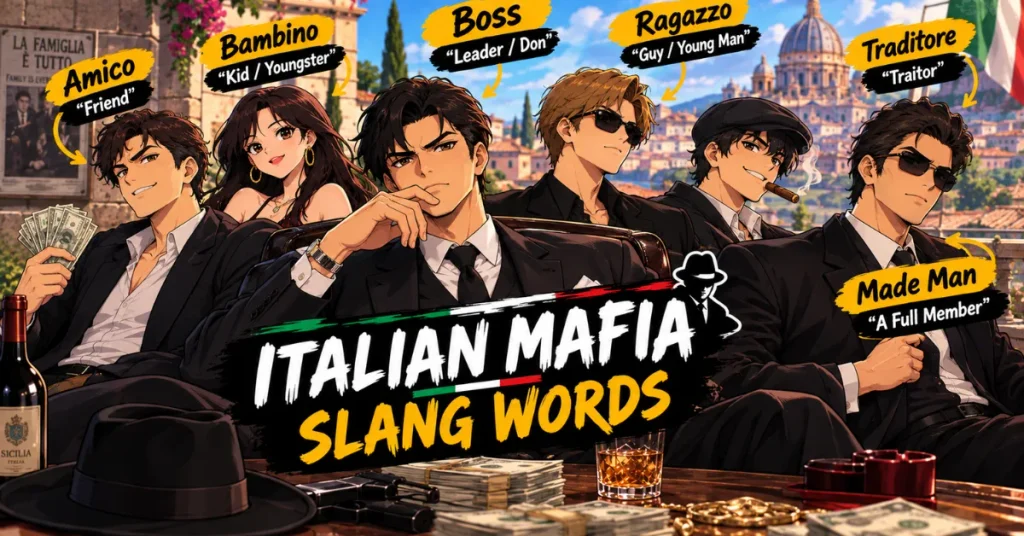
This vocabulary is interesting because it sits at the intersection of language, immigration, regional identity, organized crime, and American popular culture. Words that originated in particular communities can move far beyond their original setting and acquire new meanings through books, movies, television, journalism, and social media.
The story also shows why semantic context matters. A word like associate has a broad everyday meaning, but within La Cosa Nostra terminology it has a specific organizational sense. Similarly, family can mean relatives in ordinary English or a Mafia organization in a crime-history discussion. The surrounding entities determine the intended meaning.
Italian Mafia Slang Words: A Few More Terms Worth Knowing
Beyond the most recognizable expressions, you may encounter underboss, soldier, associate, crew, sit-down, beef, pinched, feds, earning, hit, button man, skim, rat, heat, and the Commission in Mafia-related books and entertainment. Not all of these are uniquely Italian; many are American criminal or street expressions that became associated with Mafia culture.
Sit-down is a good example. It refers to a meeting or discussion, particularly one used to resolve a dispute in Mafia narratives. Pinched means arrested, while feds commonly refers to federal law enforcement. These terms belong more to American crime vocabulary than to the Italian language itself, so labeling them simply “Italian slang” would be inaccurate.
Italian Mafia Slang Words: Taking Your Italian Speaking Deeper
If you’re learning Italian rather than simply decoding Mafia movies, it helps to separate genuine Italian vocabulary from Italian American expressions and fictional mob language. Words such as bello, amico, and pazzo are ordinary Italian words, while their presentation in a Mafia-themed article can make them seem more specialized than they actually are.
The same principle applies to pronunciation. Italian-American dialects developed through generations of language contact, and popular examples can become exaggerated in entertainment. Learning standard Italian first gives you a much better foundation for understanding why expressions such as gabagool sound different from their Italian counterparts.
Italian Mafia Slang Words: FAQs
What is Italian Mafia slang?
Italian Mafia slang is a broad label for expressions associated with Italian, Sicilian, Italian-American, and American organized-crime culture. The category includes formal Mafia terminology such as capo and consigliere, Italian-American expressions such as goombah, and American slang that became associated with mob stories.
Why did the Mafia develop its own slang?
Specialized terminology can strengthen group identity, communicate status, and provide shorthand within an organization. However, it is inaccurate to assume every Mafia expression was deliberately invented as a secret code. Many terms are ordinary words that acquired specialized meanings through organizational or cultural use.
Is Mafia slang still used today?
Many terms remain highly recognizable, but their modern visibility largely comes from entertainment, historical writing, documentaries, memes, and online culture. Federal sources continue to use established organizational terminology when describing La Cosa Nostra cases, while many older expressions are now primarily cultural references.
Which Italian Mafia slang words are most popular?
The most recognizable terms include capo, consigliere, omertà, Cosa Nostra, made man, wiseguy, Don, underboss, soldier, associate, goombah, and sit-down. Their popularity varies because some describe actual organizational roles while others became famous through movies and television.
Is it appropriate to use Italian Mafia slang casually?
It depends on the term and context. Discussing words such as capo or omertà while talking about language, history, or movies is generally straightforward. However, deliberately imitating stereotypes or using criminal terminology in serious professional situations can sound awkward or disrespectful.
Is “gabagool” actually Mafia slang?
Not technically. Gabagool is a famous Italian-American pronunciation of capicola, a cured meat. It became strongly associated with Mafia culture largely because of Italian-American characters and settings in popular entertainment. It is therefore better described as Italian-American dialect or slang rather than a Mafia rank or code word.

Daniel Parker is a writer and language enthusiast with a passion for modern slang, internet culture, and the way people communicate online.
As the creator and contributor at posmeaningslang.com, Daniel focuses on making slang words, phrases, abbreviations, and online expressions easier to understand. His goal is to provide clear definitions, useful examples, and simple explanations that help readers understand the language they encounter every day.
Daniel enjoys exploring how language evolves across social media, texting, gaming, and online communities. He believes that understanding modern slang isn’t just about knowing words—it’s about understanding the context and culture behind them.
Through posmeaningslang.com, Daniel aims to create a helpful and easy-to-use resource for anyone looking to understand today’s slang and internet language.
Areas of Interest: Slang • Internet Language • Social Media • Modern Communication • Language & Culture