Ghetto Slang Words: 30 Terms, Meanings & Real Examples
Ghetto slang words usually refers to informal expressions associated with urban speech, street language, hip-hop culture, and online conversations. Terms such as lit, cap, no cap, flex, homie, fam, drip, bet, and dope can appear in casual American English, although their histories and communities of use are different.
If you are trying to understand slang without sounding awkward or disrespectful, context matters more than memorizing a list. The phrase “ghetto slang” itself can also be loaded, especially when it is used to stereotype Black English or an entire community. This guide explains the words, meanings, cultural connections, and everyday situations where these expressions may appear.
Understanding the Origins of Ghetto Slang
Ghetto slang words are not a single formal vocabulary with one origin. Informal American expressions develop through many communities, regions, generations, and cultural movements. African American language traditions, neighborhood speech, hip-hop, regional slang, and internet culture have all influenced words that later became familiar across the United States.
The history of the word ghetto itself is much older than modern American slang. The term is connected to the Venetian Ghetto, where Jewish residents were confined in the sixteenth century. Later, American usage developed additional meanings connected with segregated or economically disadvantaged urban areas. The modern slang sense developed much later.
Understanding the Origins of Ghetto Slang
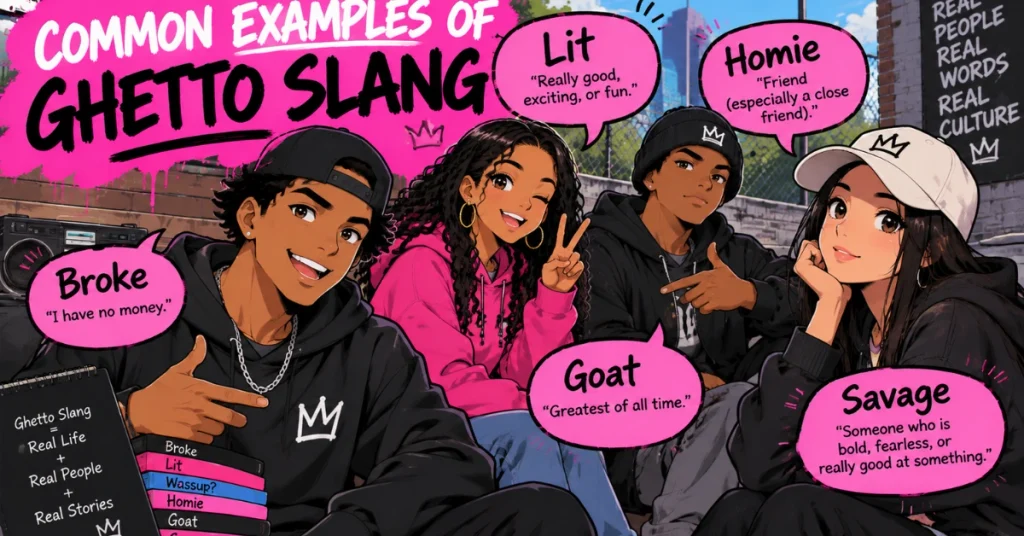
A number of expressions are popularly associated with urban or hip-hop slang, although calling every one of them “ghetto slang” is linguistically too broad. Lit can describe something exciting, while dope can mean excellent. Cap means a lie or exaggeration, and no cap emphasizes honesty.
Other familiar examples include flex, meaning to show off; homie, meaning a close friend; fam, referring to close friends or people treated like family; drip, describing stylish clothing; bet, signaling agreement; and turnt, describing an energetic or highly excited state. Usage changes by generation, region, and platform.
| Slang term | Common meaning | Typical context |
| Lit | Exciting or excellent | Parties, events, entertainment |
| Dope | Very good or impressive | Music, fashion, objects |
| Cap | A lie or exaggeration | Texting, conversation |
| No cap | Honestly; seriously | Texting, social media |
| Flex | Show off | Money, fashion, achievements |
| Homie | Close friend | Casual conversation |
| Fam | Close friend or trusted group | Texting, conversation |
| Drip | Stylish clothing | Fashion, social media |
| Bet | Okay; agreed | Texting, casual speech |
| Turnt | Very energetic or excited | Parties, events |
When Using Ghetto Slang Can Be Tricky
Slang is highly dependent on audience and situation. A phrase that sounds natural in a group chat may feel completely out of place in a job interview, classroom presentation, professional email, or formal meeting. Understanding the meaning is therefore only half the skill; recognizing when the expression fits is equally important.
There is also a cultural consideration. Some expressions come from specific communities and linguistic traditions rather than from a generic “urban” vocabulary. Using a term because it appears in a viral video does not necessarily mean you understand its history, tone, or social meaning. Listening to authentic usage is usually more reliable than copying a trend.
Common Misunderstandings About Ghetto Slang
One common misconception is that slang represents poor education or incorrect English. Linguistically, slang is informal language, and people with different educational and professional backgrounds use it. Informal speech can have patterns, meanings, grammar, pronunciation, and social rules that regular users understand intuitively.
Another mistake is treating every urban expression as “ghetto slang.” AAVE, for example, is a structured variety of English with its own grammatical and linguistic features; it should not simply be reduced to a collection of slang words. Specific expressions can also come from regional speech, youth culture, Caribbean influences, hip-hop, internet communities, or other sources.
Ghetto Slang Meaning vs the Original Meaning
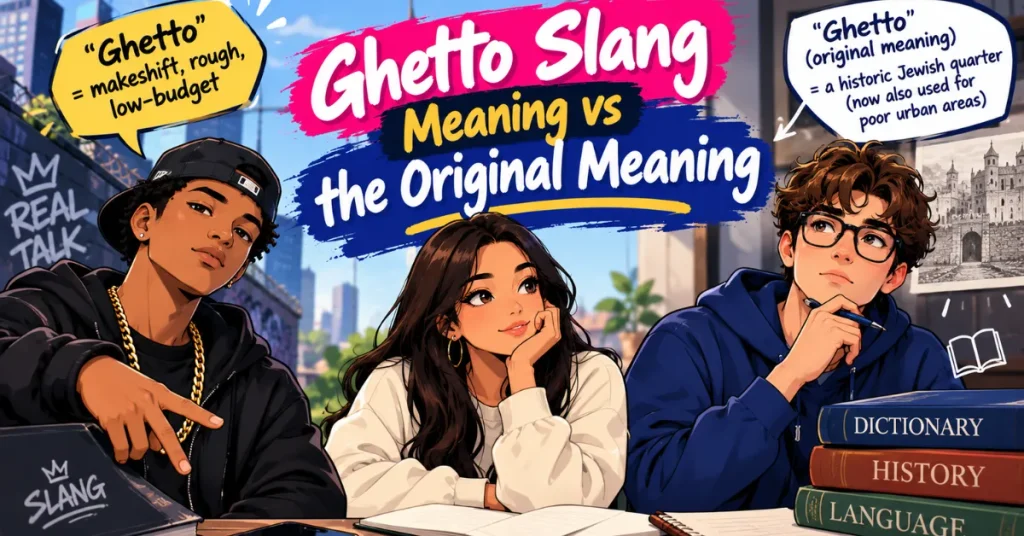
The word ghetto has a historical meaning that is separate from its modern informal usage. Historically, it referred to segregated districts, particularly areas where Jewish communities were legally restricted in parts of Europe. The word later acquired broader sociological meanings in discussions of urban poverty and segregation.
In contemporary informal speech, ghetto may be used to describe something as makeshift, rough, inexpensive, unconventional, or improvised. That shift is important because the slang adjective can carry class-based or racial implications depending on what is being described. Dictionaries and language references commonly identify this use as potentially disparaging.
Ghetto Slang Examples in Real Conversations
Consider a casual conversation about a broken phone stand: “I used two books and some tape to hold it up. It’s ghetto, but it works.” Here, the speaker is using the word humorously to describe an improvised solution rather than describing a person or community.
The meaning changes when the word is applied to someone’s identity, neighborhood, appearance, or background. In those situations, the expression can sound judgmental or stereotypical. A clearer alternative might be makeshift, improvised, low-budget, rough, unfinished, or unconventional, depending on the intended meaning.
Ghetto Slang in Hip Hop and Pop Culture
Hip-hop has played a major role in spreading regional and community-specific expressions into mainstream American culture. Music can introduce vocabulary to huge audiences, while movies, television, podcasts, memes, and social platforms accelerate the process. A word that once felt geographically specific can eventually become familiar nationwide.
Social media has made that process even faster. TikTok, Instagram, YouTube, and X can push expressions from one community into millions of conversations within a short period. At the same time, widespread adoption can separate a word from its original cultural context, which is why knowing where an expression came from can be as useful as knowing its dictionary-style meaning.
Ghetto Slang Meaning in One Quick Table
| Expression | Meaning | Context |
| That’s ghetto | Rough, improvised, or unconventional | Informal |
| Ghetto setup | Makeshift arrangement | Casual |
| Ghetto fix | Improvised repair | Casual |
| Ghetto fabulous | Bold or glamorous style | Fashion/pop culture |
| Lit | Exciting or excellent | Casual |
| Cap | Lie or exaggeration | Texting |
| No cap | Truth or honesty | Texting |
| Flex | Show off | Social media/conversation |
| Homie | Close friend | Casual |
| Fam | Trusted friend/group | Casual |
| Drip | Stylish clothing | Fashion |
| Bet | Agreement | Casual/texting |
The safest way to understand these expressions is to treat them as context-dependent slang, not as one uniform dialect. Some terms have strong cultural histories, while others have spread so widely that people encounter them without knowing their origins. The phrase “ghetto slang” itself can also be less precise than terms such as urban slang, street slang, regional slang, or a specific linguistic tradition.
If your goal is simply to understand what someone said, focus on the particular word and the surrounding sentence. If your goal is to use slang naturally, pay attention to who uses it, where they use it, and what tone it carries. That approach gives you a much better understanding than memorizing a dictionary-style list.
The historical distinction here is important: reputable reference material traces ghetto to the Venetian context and notes that its etymology itself is disputed, while modern American usage has developed additional sociological and informal senses.
FAQ Section
What are some ghetto slang?
Some commonly associated slang terms include homie, fam, lit, dope, cap, no cap, flex, drip, bet, and turnt.
What is ghetto in slang?
In slang, “ghetto” can describe something rough, makeshift, unconventional, or low-budget. When used about a person or community, it can sound offensive or stereotypical.
What are some gangster slang words?
Examples include OG, homie, crew, turf, beef, ride-or-die, and clique. Meanings can vary by region and context.
What are 10 slang words?
Lit, cap, no cap, flex, drip, bet, homie, fam, dope, and turnt.

Daniel Parker is a writer and language enthusiast with a passion for modern slang, internet culture, and the way people communicate online.
As the creator and contributor at posmeaningslang.com, Daniel focuses on making slang words, phrases, abbreviations, and online expressions easier to understand. His goal is to provide clear definitions, useful examples, and simple explanations that help readers understand the language they encounter every day.
Daniel enjoys exploring how language evolves across social media, texting, gaming, and online communities. He believes that understanding modern slang isn’t just about knowing words—it’s about understanding the context and culture behind them.
Through posmeaningslang.com, Daniel aims to create a helpful and easy-to-use resource for anyone looking to understand today’s slang and internet language.
Areas of Interest: Slang • Internet Language • Social Media • Modern Communication • Language & Culture